Esri News Feed

Showing posts with label solar. Show all posts

Tuesday, September 27, 2011

Mapping Planetary Rotation in a Binary Star System

This link comes from NASA's Image of the Day and shows how the planetary system might look to a visiting spaceship.


A "Cut and Paste" highlight from the site:


Kepler-16b: A Planet with Two Suns

" Explanation: If you stay up long enough, you can watch both suns set. Such might be a common adage from beings floating in the atmosphere of Kepler 16b, a planet recently discovered by the space-based Kepler satellite. The above animated video shows how the planetary system might look to a visiting spaceship. Although multiple star systems are quite common, this is the first known to have a planet. Because our Earth is in the orbital plane of both stars and the planet, each body is seen to eclipse the others at different times, producing noticeable drop offs in the amount of light seen. The frequent eclipses have given Kepler 16b the most accurate mass and radius determination for a planet outside our Solar System. To find a planet like Saturn in an orbit like Venus -- so close to its binary star parents -- was a surprise and will surely become a focus of research."

Full credits:
APOD NASA Authors & editors: Robert Nemiroff (MTU) & Jerry Bonnell (UMCP)
NASA Official: Phillip Newman
Specific rights apply.NASA Web Privacy Policy and Important Notices
A service of: ASD at NASA / GSFC & Michigan Tech. U.

Illustrated Video Credit: NASA, JPL-Caltech, T. Pyle; Acknowledgement: djxatlanta

Wednesday, February 23, 2011

Mapping Units of Measure -Size is relative in the Universe

Size is "relative" in the universe.


From the NASA APOD Project:
Star Size Comparisons


Credit & Copyright: morn1415 (YouTube)


Explanation: How big is our Sun compared to other stars? In a dramatic and popular video featured on YouTube, the relative sizes of planets and stars are shown from smallest to largest. The above video starts with Earth's Moon and progresses through increasingly larger planets in our Solar System. Next, the Sun is shown along as compared to many of the brighter stars in our neighborhood of the Milky Way Galaxy. Finally, some of the largest stars known spin into view. Note that the true sizes of most stars outside of the Sun and Betelgeuse are not known by direct observation, but rather inferred by measurements of their perceived brightness, temperature, and distance. Although an inspiring learning tool that is mostly accurate, APOD readers are encouraged to complete the learning experience -- and possibly help make future versions more accurate -- by pointing out slight inaccuracies in the video.

Thursday, July 23, 2009

Cool Geo-Pic: Eclipse - Prophesy or Shadow? Depends on your point of view.


This Cool Geo-Pic comes again from NASA's Earth Observatory. While I've seen some wonderful eclipse images, this is the first that's from the "moon"s point of view".

Funny how a prophetic event to one, is just a shadow to another. Makes me wonder what an ant dreams up when he encounters my "looming darkness" on a sunny Sunday sidewalk stroll. Eghads! It blocks out the sun!

Another example that all things are relative to your point of view.

Quick "Cut & Paste" Highlights:

" ... The Moon’s shadow engulfed Taiwan and a large swath of southeastern China and the Pacific Ocean on the morning of July 22, 2009, during an unusually long total eclipse of the Sun. This pair of images from the Japanese geostationary satellite MTSAT show the view of Earth at 8:30 a.m. local time in Taiwan (left) and an hour later (right), near the time in eastern China when the disk of the Moon completely overlapped the disk of the Sun (called totality). The longest period of totality occurred over the Pacific, where the total eclipse lasted more than 6 minutes...."


download large 8:30 image image (90 KB, JPEG) acquired July 22, 2009

download large 9:30 image image (94 KB, JPEG) acquired July 22, 2009

Full Article - Click Here

References / Credits:

Exploratorium.edu. (n.d.) Total Solar Eclipse, July 22, 2009. Accessed July 22, 2009.
U.S. Naval Observatory. (n.d.)
The Sky This Week, 2009 July 17 – 24. Accessed July 22, 2009.
Espenak, F. (n.d.)
Total Solar Eclipse of 2009 July 22. NASA Eclipse Website. Accessed July 22, 2009.
Images provided by
WebGMS–MTSAT/GMS (HIMAWARI) Website, Institute of Industrial Science & Earthquake Research Institute, University of Tokyo, Japan.
Instrument:
MTSAT

Saturday, May 16, 2009

Visualizing the US Alternative Power vs. Current Grid


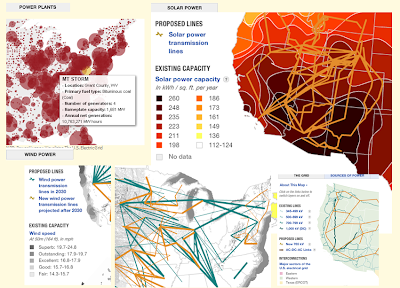
This visualization of the current national power grid and comparisons of several alternative energy "landscapes" (Solar, Wind, etc.) is an intriguing comparison of current power network to potential new sources of energy in an environment of ever increasing "power-hungry" demand.


Quick "Cut & Paste" highlights:


The nation’s electricity grid is facing a crisis -- it’s outdated and unprepared for increasing demand and a future that includes more renewable sources of energy. A new digital smart grid is part of the picture envisioned by advocates, as is building new electricity infrastructure.


Credits:

To Flowing Data for bringing it to my attention, and these NPR folk (below) for putting it together:


Sources: American Electric Power, American Wind Energy Association, Center for American Progress, Department of Energy, Edison Electric Institute, Energy Information Administration, Electric Power Research Institute, Federal Energy Regulatory Commission, National Renewable Energy Laboratory, U.S. Environmental Protection Agency, Western Resource Advocates
Credits: Producer: Andrew Prince; Designer: Alyson Hurt; Editors: Avie Schneider and Vikki Valentine; Supervising Editors: Anne Gudenkauf and Quinn O'Toole; Additional Research: Jenny Gold; Database and GIS Analysis: Robert Benincasa