Esri News Feed

Thursday, October 20, 2005

Mapping the Iraqi Election


http://www.style.org/iraqielection/

An interesting display of the election results.

Taken from one of my GIS e-magazines:

Mapping the Iraqi Election and Morecompiled by Nora Parker, Managing Editor

Don Cooke of Tele Atlas alerted us to an interesting
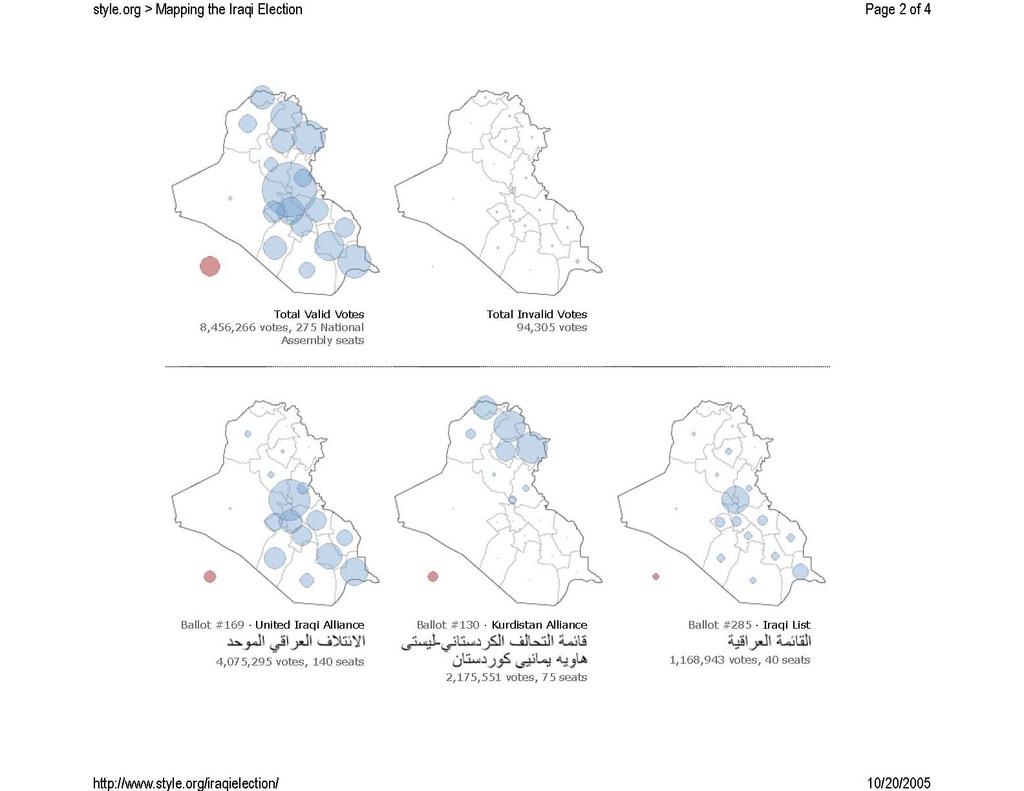
website, published by Jonathan Corum of 13pt. Not only does it have some interesting maps (like the January 2005 Iraqi election one shown below), but other fun goodies such as a "composite panorama of Mars" and "The Strouhal Number in Cruising Flight" which has to do with the fact that animals swimming or flying at cruising speed use "similar ratios of stroke frequency and amplitude to forward speed." The Iraqi maps break down the vote in each of 18 governates by eight political parties. The map below shows the total valid votes by governate.

Out-of-country votes are indicated by the red dot to the southwest, outside the country boundary. The maps are interactive and allow you to choose various display parameters.

15 bad things...

From one of my GIS magazines, and interesting summary of 15 bad things...

Our nation faces numerous threats. Many citizens have come to expect the Department of Homeland Security (DHS) to protect us. But from what? Not all these threats carry guns, wear uniforms or build bombs. Earlier this year, the New York Times reported that DHS had created 15 detailed scenarios (listed below) that represent real and critical security threats. Few people realized that only a few months later, one would have occurred (major hurricane) and indications suggest a second one is on the way to becoming a reality.

DHS Scenarios

  • 1.) Nuclear detonation: 10 kiloton nuclear device*
    2.) Biological attack: aerosolized anthrax*
    3.) Biological disease outbreak: flu pandemic
    4.) Biological attack: pneumonic plague
    5.) Chemical attack: blistering agent
    6.) Chemical attack: Toxic industrial chemicals*
    7.) Chemical attack: nerve agent
    8.) Chemical attack: chlorine tank explosion*
    9.) Natural disaster: earthquake
    10.) Natural disaster: major hurricane
    11.) Radiological attack: dirty bomb*
    12.) Explosives attack: improvised bombs*
    13.) Biological attack: food contamination**
    14.) Biological attack: foot and mouth disease
    15.) Cyber attack*

Friday, October 14, 2005

A "Dam" Funny Email

-----This is an actual (?) letter sent to a man named Ryan DeVries by the Michigan Department of Environmental Quality, State of Michigan. This guy's response is hilarious, but read the State's letter before you get to the response letter. (This is the State's Letter!) (?)

SUBJECT: DEQ File No.97-59-0023; T11N; R10W, Sec. 20; Montcalm County


Dear Mr. DeVries:

It has come to the attention of the Department of Environmental Quality that there has been recent unauthorized activity on the above referenced parcel of property. You have been certified as the legal landowner and/or contractor who did the following unauthorized activity:

Construction and maintenance of two wood debris dams across the outlet stream of Spring Pond.

A permit must be issued prior to the start of this type of activity. A review of the department's files shows that no permits have been issued. Therefore, the Department has determined that this activity is in violation of Part 301, Inland Lakes and Streams, of the Natural Resource and Environmental Protection Act, Act 451 of the Public Acts of 1994, being sections 324.30101 to 324.30113 of the Michigan Compiled Laws, annotated.

The Department has been informed that one or both of the dams partially failed during a recent rain event, causing debris and flooding at downstream locations. We find that dams of this nature are inherently hazardous and cannot be permitted. The Department therefore orders you to cease and desist all activities at this location, and to restore the stream to a free-flow condition by removing all wood and brush forming the dams from the stream channel. All restoration work shall be completed no later than January 31, 2005.

Please notify this office when the restoration has been completed so that a follow-up site inspection may be scheduled by our staff. Failure to comply with this request or any further unauthorized activity on the site may result in this case being referred for elevated enforcement action. We anticipate and would appreciate your full cooperation in this matter.Please feel free to contact me at this office if you have any questions.

Sincerely,

David L. Price, District RepresentativeLand and Water Management Division


** Here is the actual response sent back by Mr. DeVries: **Re: DEQ File No. 97-59-0023; T11N; R10W, Sec. 20; Montcalm County.

Dear Mr. Price,

Your certified letter dated 12/17/02 has been handed to me to respond to. I am the legal landowner but not the Contractor at 2088 Dagget, Pierson, Michigan. A couple of beavers are in the process of constructing and maintaining two wood "debris" dams across the outlet stream of my Spring Pond.

While I did not pay for, authorize, nor supervise their dam project, I think they would be highly offended that you call their skillful use of natures building materials "debris." I would like to challenge your department to attempt to emulate their dam project any time and/or any place you choose.

I believe I can safely state there is no way you could ever match their dam skills, their dam resourcefulness, their dam ingenuity, their dam persistence, their dam determination and/or their dam work ethic.

As to your request, I do not think the beavers are aware that they must first fill out a dam permit prior to the start of this type of dam activity.

My first dam question to you is: (1) Are you trying to discriminate against my Spring Pond Beavers, or (2) do you require all beavers throughout this state to conform to said dam request? If you are not discriminating against these particular beavers, through the Freedom of Information Act, I request completed copies of all those other applicable beaver dam permits that have been issued. Perhaps we will see if there really is a dam violation of Part 301, Inland Lakes and Streams, of the Natural Resource and Environmental Protection Act, Act 451 of the Public Acts of 1994, being sections 324.30101to 324.30113 of the Michigan Compiled Laws, annotated.

I have several concerns. My first concern is; aren't the beavers entitled to legal representation? The Spring Pond Beavers are financially destitute and are unable to pay for said representation -- so the State will have to provide them with a dam lawyer. The Department's dam concern that either one or both of the dams failed during a recent rain event, causing flooding, is proof that this is a natural occurrence, which the Department is required to protect. In other words, we should leave the Spring Pond Beavers alone rather than harassing them and calling their dam names.

If you want the stream "restored" to a dam free-flow condition please contact the beavers -- but if you are going to arrest them, they obviously did not pay any attention to your dam letter, they being unable to read English.

In my humble opinion, the Spring Pond Beavers have a right to build their unauthorized dams as long as the sky is blue, the grass is green and water flows downstream. They have more dam rights than I do to live and enjoy Spring Pond. If the Department of Natural Resources and Environmental Protection lives up to its name, it should protect the natural resources(Beavers) and the environment (Beavers' Dams).

So, as far as the beavers and I are concerned, this dam case can be referred for more elevated enforcement action right now. Why wait until 1/31/2005? The Spring Pond Beavers may be under the dam ice then and there will be no way for you or your dam staff to contact/harass them then.

In conclusion, I would like to bring to your attention to a real environmental quality (health) problem in the area. It is the bears! Bears are actually defecating in our woods. I definitely believe you should be persecuting the defecating bears and leave the beavers alone. If you are going to investigate the beaver dam, watch your step! (The bears are not careful where they dump!)Being unable to comply with your dam request, and being unable to contact you on your dam answering machine, I am sending this response to your dam office.

THANK YOU.

RYAN DEVRIES & THE DAM BEAVERS

Wednesday, August 31, 2005

What is GIS in 100 words or less?

These are the submissions orginally posted on GeoReport's GeoPoll at GeoPlace.com:


GIS allows two-way communication between a database and a map. It lets you "see" the data on a map, and allows you to ask questions about the data using the map.
- Dave FritzkeCity of Crystal, Minnesota

A software system that ties geographic data (maps) and non-geographic data together, allowing for map-based display of data relationships. Without the map component, it's called data mining.
- Kerry Maloney

Almost everything has a location. GIS is a way to store that information and see how things are related to each other, from pipelines underground to the streets to the trucks driving on top of them.
- Barry Waite

Nearly everything in the world exists in a physical space. From the chair you’re sitting in, to the way you drive home, to the boundary of your city, to the events you saw on the news last night. GIS allows us to store information about these locations and examine relationships with other location information to gain a better understanding of our world.
- David Brand

GIS is a tool that allows data and information to be displayed visually on a map.
- Richard Hoiland

GIS is a computer based means of precisely locating and identifying a specific location along with the ability to gather, use, and disseminate data about the location resulting in much better understanding and knowledge than otherwise would be possible.
- Marcus Wood

GIS is the practice of integrating data or information about a place on a map so that a user has the combination of features to fully describe that place in terms that they understand and use regularly in their job or personal activities.
- Gary W. KerrAllstate Insurance Company

GIS is when you know the location of something in, on or above the earth and putting that location into context with things around it at a known point in time. Data about that point and things surrounding it can be combined, compared and analyzed. This information may be viewed or heard in a medium best suited for the user to utilize that knowledge. The combined knowledge about the position of things is used for everything from guiding the end of a laser during eye surgery, intercepting an incoming missile to providing a map to your closest grocery store.
- Erv Rehman

An organized collection of computer technology, geographic data, and personnel designed to efficiently capture, store, update, manipulate, analyze, and display geographically referenced information.
- Hassan

A GIS is any data set that includes a geographical tag or attribute that enables that data to be analyzed and presented geographically to enhance the quality of decision making.
- Kevin Davies

GIS is a computer-based mapping of landscape features of a known geographic location that allows integration of the non-geographics characteristics of these features to describe the event over landscape at time.
- Meshack Nyabenge

GIS can be thought of as a type of computerized or digital mapping where the maps are spatially accurate and interactive in the sense that they may be used to perform spatial analysis or communicate information about a location in an easily customizable manner. For instance, data about multiple different phenomena are easily brought together to reveal new information from which conclusions may be drawn or decisions made, or the data may be reflected in a variety of different styles to communicate information about a location.
- Mike Espey

GIS is a representation, dissemination and integration of data or information by defining its attributes. When working with GIS, it involves data, various software’s and human resources. The GIS data can be in tabular, map etc. The following activities are involved to achieve a working GIS; these are data capture, input, conversion, database design and management. Any data can be represented using GIS. Our every day-to-day activities can be represented in a GIS.
- C. Disang

GIS is people applying technology to the acquisition and use of spatial information for some desired benefit.
- Paul J. DeFrancisco, Data Services Specialist, New York State Senate Research Service

Thursday, August 11, 2005

Best Damn Haircut ... Ever!

Sometimes the simplest things in life, so often reduced to commonality by the daily mundane, defy the mediocre routine and rise up in rare moments of absolute excellence. Who expects excellence when you walk into a humble barbershop?

For all Bloggers in a 70 mile proximity of the Dominion Barber Shop in McLean, VA, stop by for a haircut ... You'll walk away cleanest, refreshed and impressed. Do I care how it looks? Not really... I'm a guy, I got a haircut and now my hair is short. What matters is how (and for how much) I got a haircut. In my 35 years of existence, I've never had a better cut experience. That's how good my last haircut was. I live in Florida, but I will now save my haircuts for when returning there to visit hometown family and friends.

First, this is not a hair salon, follicle spa or other such confusion (no Jonathan Product here ...), this is a no nonsense barber shop. You walk into a small shop tucked in a building complex in the heart of old McLean. The staff are polite, pleasant and professional, with the graceful understanding that men just need a barber. The conversation was limited to a zen-like brevity. "How do you want it cut?" "Short", I replied. Nothing more had to be said, and amazingly nothing was. No pretense of friendship, no "pretend your a regular" schmooze... Just sit down, we'll both shut up, and you'll get the best damn haircut of your life.


The female barber (barberette?) began with the buz cutters. OK, typical so far. Then she went for the shears, and began snipping away. This is where it usually ends with every other haircut. More buzzed than cut, you look in the mirror and say "thank you", really thinking "hell, I used to that to myself in college" and give the person twenty five bucks after tip. You pay the bill, and weakly wave while exiting, turning in motion to mutter some cliche goodbye like "See you next month" (not likely).

Now return to Dominion Barber Shop in McLean, VA, where a little bit of heaven can be found. My barber(ette) snipped a lot, then went back to the buzzers, then returned to hand snipping around my ears and neck. Now, I'm moderately impressed. Usually its the one-two treatment, and your oughta there. I even looked up, trying to determine was this an unusually thorough treatment, or did she just make a lot of mistakes. Nope, she really cares about the purity and perfection of a good cut. Still, nothing to this point is blog-worthy.

Then the improbable, followed by a rarity and closing with and act nearing the sanctity of ceremony occurred.

First, the barber applied a gel shaving foam to my back neck and sideburn edges. One of those cool, skin percolating shaving creams that were tre' chic in the '80s. Its got the "sshhhschk" sound coming out of the can, then the alovera smell and cool mint-tingling touch all in one package. Then, she shaves me not with a razor, or the latest Gillette Ultra-Rip Off, but a real folding barber blade. I flash to all those old west barber shop scenes and the one scene where an Al Capone-Robert Dinero gets nicked. No worries here, just a smooth shave.

I am now openly smiling, trying to sit up straight and hold back a "...Wow... Cool..." even.

O.K. Now the rarely seen in these western lands.... A neck and shoulder massage. She pulls out some hand glove device, fashioned out of metal and rubber. It looks like a bizarre cat hair glove gone S&M, but she hits me with it so fast I can't even think "what the hell is that thing, lady", before she kneading it into my neck and shoulder. It's vibrating on my neck, she's driving it into knots I've had so long I thought I was supposed to hang my shirts on them. Before I can regain my silent composure, I actually utter "....Wow... Cool". This isn't only cool, its manly even.

Finally, the ritual of sanctity. After doing the usual "remove the gown and brush down" post-hair cut routine, the barber takes a hot scented towellete and wipes my face and neck down. She didn't even ask. Its like "in your face" refreshed.

We approach the counter in silence; me still grinning foolishly and rubbing the back of my now slick neck, like some cowboy getting up in recovery after his first bull ride.

She punches the cash register, smiles, and says ""$15, please. There's a free coke or water around the corner." Price? $15? And you get a free soda to go? I gave here a $5 tip, and still feel the wisely miser.

Let's recap:
1.) Man needs haircut, because wife says so, and because she hates when man does it himself.

2.) Therefore, man hates haircuts, because haircutteries' today do exactly what man do, but cost money, and because wife somehow thinks this is better solution.

3.) Man finds small, simple, clean BARBER shop. (No fu fu)

4.) Barber is barberette who does not talk.

5.) Conversation in detail
- "How do you want it cut?"
- "Short"
- "...Wow... Cool..." (only thought)
- "...Wow... Cool..." Actually said.
-"$15, please. There's a free coke or water around the corner."

6.) BEST DAMN HAIRCUT EVER.

Dominion Barber Shop
6665A Old Dominion Drive
McLean, VA 22101
703.917.9025
Mon-Fri : 9am - 7pm
Sat : 8am - 6pm
Sunday 11am - 5pm

Monday, August 08, 2005

What Not To Do With Maps ....

This was recently posted with Crain's. Hardly the Thomas Crown Affair, but an interesting story.

http://chicagobusiness.com/cgi-bin/news.pl?id=17381

Map dealer suspected in Newberry Library thefts
Accused appears in court Tuesday charged with other thefts in Boston and London
(AP) — A renowned map dealer accused of stealing centuries-old artifacts from Yale University is scheduled to be in court Tuesday in a case that investigators hope will lead them to several antique maps that recently disappeared from other libraries.

In the eight weeks since Edward Forbes Smiley III was arrested at Yale with a razor blade and a cache of maps worth nearly $900,000, libraries in Chicago, Boston and London have reported finding gaps in their collections.

"We know that Smiley looked at four books, so we have taken those four books, we've turned every page and we think he may have taken two maps," said Charles T. Cullen, president of the Newberry Library in Chicago.

Smiley, 49 was arrested on larceny charges June 8 after a librarian at Yale's Beinecke Rare Book and Manuscript Library found a razor blade on the floor. Police confronted Smiley, who had been reviewing rare books, and asked whether the blade was his.

"Yes it is," he nervously replied, according to a police report. "I must have dropped it. I have a cold."

Officers searched Smiley's briefcase and pockets, and recovered three maps stolen from Yale and four maps that investigators are trying to trace. Smiley told investigators the maps were his and he wanted to compare their quality to those in Yale's collection.

Smiley declined to comment Monday when reached at his office on Cape Cod. His attorney said Smiley will plead not guilty Tuesday.

The arrest touched off an FBI investigation and prompted a review of rare map collections worldwide. Rare maps frequently are contained in old books or folios, making it easy for thieves to remove them without the library noticing they are missing.

The British Library in London recently discovered that two world maps from the 1500s and a map of New England from 1624 were missing. Newberry librarians said a 1673 map of Virginia and a map of South Carolina from the 1700s were missing from books Smiley had reviewed.

The Boston Public library also discovered maps missing from books Smiley had studied. The New York Public Library is still reviewing the many books Smiley used there. Ronald E. Grim, map curator at the Boston Public Library, said Smiley was always friendly with librarians.

"He had a good way of making friends," he said. "He had a good rapport."

But in the small community of antique map dealers, Smiley had a mixed reputation.

"Forbes was turning up things that aren't possible to turn up, and at a third or fourth of the wholesale price," said Pennsylvania map dealer W. Graham Rader, who said he told federal agents that he's been warning collectors about Smiley for years. "Things were too good to be true."
Tony Campbell, former head of the map collection at the British Library, said collectors complained that Smiley had an exclusive air about him.

"Their comments were always critical," Campbell said. "But I don't think anyone thought - I think we were all surprised by this."

Though Smiley reviewed many of the books that librarians have since realize are missing maps, the FBI has so far been unable to link him to the thefts, librarians said.

At the Newberry, Cullen said curators know the maps were in the books when they were catalogued, that Forbes was the last person to view the books and that the maps are now missing. But they don't know whether they were in the books when Forbes reviewed them, he said.

"Obviously, I think that Smiley took it, but I couldn't go into court and say that," Cullen said.

The Boston Public Library is having the same problem.

"Proving that those items were there when he looked at the book is almost impossible," Grim said.
Frank Turner, director of the Beinecke Library, said curators and librarians are constantly working to protect their archives without burdening scholars who need access to the materials.

"We're all now reviewing those procedures," Turner said.

Tuesday, August 02, 2005

The 11th Commandment


Eleventh Commandment (Walter Lowdermilk) In 1939 this appeared in a Bulletin of the US Department of Agriculture:

"Thou shalt inherit the Holy Earth as a faithful steward, conserving its resources and productivity from generation to generation.Thou shalt safeguard thy fields from soil erosion, thy living waters from drying up, thy forests from desolation, and protect thy hills from overgrazing by thy herds, that thy descendents may have abundance forever."

"If any shall fail in this stewardship of the land, thy fruitful fields shall become sterile stony ground and wasting gullies, and thy descendents shall decrease and live in poverty or perish from off the face of the earth."

• quoted on page 58 of Lester Brown, Plan B, from Walter C. Lowdermilk, Conquest of the Land through 7,000 years, USDA bulletin No. 99 (Washington, D.C., U.S. Department of Agriculture, Natural Resources Conservation Service, 1939. note 1 page 24.

Tuesday, July 26, 2005

On Investing and the 2005 Economy - Thoughts by Rolf Clark

On Investing and the 2005 Economy

Study of various analyses on the American and global economy lead one to think that a near term global recession is likely. This implies investors should be out of the stock and bond markets for the next year or two, putting funds into either a money market or very short term treasuries. Some funds (perhaps 20 percent) might go into gold equities to capitalize on an expected near term fall in the dollar. After the global recession bottoms out, investors should not reinvest in US equities but rather buy Asian equities (excluding Japan), for that region seems to be where real future growth will occur.

The relevant factors: (1) The US has accumulated severe private debt as well as moderate government debt; (2) as a result the dollar is vulnerable on the international exchange; (3) that’s because the collective private and public deficits have led to impressive foreign holdings of US financial assets, making the dollar vulnerable if foreign investors abandon it; (4) for years business has invested in high tech industries and not in the manufacturing industries that hire average workers (thus there are inadequate jobs for the large blue collar work force); (5) foreign labor is both cheap and now highly skilled, so even US high tech jobs are at risk; (6) the “baby boom” demographics of aging will be detrimental to future US growth.

A major consideration behind these comments concerns risk avoidance. Specifically, avoiding a major loss at the risk of foregoing a marginal gain is intelligent risk aversion tactic (discussed further below).

Rational
Americans have collectively borrowed from overseas sources to make up for the government deficits and inadequate private savings of recent years. In 1982 Americans saved about 11 percent of their income. Since then that savings rate has gradually fallen to under 3 percent now. Private sector debt has risen from 95 percent of GDP in 1970 to 240 percent in 2004. In the same period the government debt has changed from 38 percent to 62 percent of GDP.

In short, the nation is saving a lot less than it used to. The US has been consuming, instead of saving for productive investment. Consumers have borrowed on the equity of their homes to maintain spending levels and thereby made GDP gains possible.

When national savings fall short of national expenditures, we borrow the difference from overseas. And overseas investors have the dollars to loan us because we run trade deficits – we import more than we export. That means dollars accumulate overseas (especially in major US purchasing areas: Japan, China, and Europe). What happens to these overseas held dollars? Some are loaned back to the US to cover deficits. Some are used to buy US assets. And some are held in reserve by foreign banks.

If these foreign held dollar reserves are sold on the currency markets (due to concern over the dollar resulting from large US debts and lowered productivity) then the dollar will indeed fall. And a falling dollar leads to further dollar sales. Then US assets (stocks and bonds) lose value and holding them becomes costly. Thus the argument to get rid of them now.
Also, if the dollar falls, interest rates will need to rise in order to slow the dollar’s fall and still obtain new loans from overseas. After all, the nation’s deficit spending still needs to be covered.

The higher interest rates will make the large cumulative debts – especially those in housing - dangerous. As housing prices have risen, investors have borrowed to speculate on new housing. Further, home buyers have used the increased value of their houses as collateral to borrow funds to consume more, and to speculate further on housing and other real estate investments (eg, Florida condos).

The loans will remain fixed while the speculative “housing bubble” bursts, home values fall, and mortgage payments rise as variable interest rates rise (a large fraction of recent purchases were made with imaginative financing meant to reduce up front payments). Speculators will not be able to make the now higher payments. New loans to pay existing payments will demand even higher rates. As housing prices fall, speculators who had counted on paying off loans by selling their houses before the mortgage payments came due will find they cannot pay them nor afford to refinance them. Meanwhile housing prices fall further yet.

Additionally, US stocks are currently quite highly valued. The S&P 500 index has stocks selling at over 40 times earnings, a very high figure historically. Thus, stocks are likely to fall anyway, but when viewed in the light of a housing bubble, may well collapse as investors sell them to cover their housing mortgages.

A severe recession or depression can result from the combined fall in the dollar, a stock market decline, and the housing bubble bust. And when the US has a major recession the world suffers … for we import much from other economies. Thus a global recession.

Since this global recession may happen in the near future, it seems a good time to be highly liquid. That will leave cash ready to invest in the next global growth phase after the anticipated recession.

Where to invest when growth returns
The US is no longer the area of most potential future growth. It no longer leads in manufacturing. Instead it has overspent in high tech industries that hire few average skill workers. With modern communications, even high tech jobs are outsourced to lower wage countries such as India and Ireland.

Further, the US population is aging. That means more US funds will be spent on Social Security and Medicare instead of on investment in productivity enhancing production.

Some baby boomers have already begun retiring, and retired people spend less, especially if they have saved little. That upcoming drop in consumption will further reduce US growth. Japan’s and Europe’s population are aging even sooner than the US’s, making them undesirable investment alternatives.

It is noteworthy that Japan’s falling stock market era started in 1990 and has now lasted for 15 years. Japan was the apple of the investors eye before 1990. The point is that great economies can suffer for long periods. Further, the US baby boom lags Japan by 10 years, so baby boom dynamics would dictate that the US financial problems became suspect starting in 2000. That indeed is when the US stock market fell heavily, and it has not recovered nor might it for the next ten years if we accept Japan for our model.

The next phase of economic growth will likely occur in East Asia and India. Once the global recession passes East Asia seems to be the area to invest in. They are poised for manufacturing growth such as occurred in the USA, Germany, and Japan in the past. China’s growth is certainly well known.

There is an exception to remaining out of stocks totally. If the dollar is to fall, then putting some funds into gold would be appropriate as gold usually rises if the dollar falls. This can be done by obtaining a gold “exchange traded fund” (or ETF). One such ETF has the market symbol “IAU”, which is traded just like a corporate stock.

Recent history of the stock market
There are empirical stock market dynamics since 1929 relevant to our discussion of a bearish future for the US market. Specifically, the market was bearish from 1929 to 1946 (17 years). It was bullish from 1946 to 1965 (19 years), bearish from 1965 to 1982 (17 years), bullish from 1982 to 2000 (18 years). It would be consistent with this pattern for US stocks to be bearish for 17(?) years from 2000 on. That would reinforce the argument to avoid US equities which have only been bearish for 5 years since 2000.

Implications:
Put most funds into money markets or short term treasury notes until the predicted global recession passes, then invest to take advantage of East Asian growth for a decade or so. If desired, invest in gold for the near term to take advantage of the falling dollar.

When the time comes, there are ETF’s for Asian investments. And with the strong growth in China and India, investment in commodities (energy, food, raw materials) would then be appropriate. But such investment decisions do not need to be made until the global recession eases.

Risk Aversion
The above recommendations are bolstered by a risk-adverse logic. Suppose the US economy does not experience a near term recession. Applying the above recommendations then would mean one forgoes possible gains in the US stock market. One might forgo, say, a 15 percent gain when getting out of stocks for an expected recession that does not happen. 15 percent is not a major sacrifice. But, on the other hand, if one stays with stocks while a major recession occurs, a loss of 50 percent (or more) of a portfolio’s value could occur before counteraction can be taken. That would be a major setback for most people.

Suppose, to make the point, that even a 100 percent gain was foregone by putting the funds in a money market to counter the potential 50 percent loss. For many of us a loss of 50 percent of our portfolio is not acceptable, even if what is given up is a 50-50 chance of a doubling of the funds. Depending on our situation, a doubling of funds is not as beneficial as halving them is detrimental. A retiree, for example may not be able to withstand a halving of assets, no matter how large the potential gain foregone.

So for many of us, the housing bubble, the deficits, the migration of jobs to Asia, are real enough indicators of a recession to argue for the safer road of accepting money market returns for the next year or two…maintaining the flexibility to jump in with both feet once the recession, or its threat, has passed.

Rolf Clark
July 2005

Thursday, July 14, 2005


Iraq War Fatalities Animated Map

Posted by Picasa

Iraq War Fatalities Animated Map

Iraq War Fatalities
First reported by Nora Parker, Senior Managing Editor, DirectionsMag.com

Graphic designer Tim Klimowitz created this
animated map (you'll first see a red button, and then the animation begins) of Iraq showing US and coalition military fatalities per day during the war. Klimowitz says that he was trying to create "something as objective and apolitical" as possible. My nine year old daughter happened to wander into my office while I was looking at the site, and based on her reaction, it was quickly apparent that the map communicates information in a way that could be quickly grasped by almost any audience. According to Klimowitz's description on the site:

"The animation runs at ten frames per second -- one frame for each day -- and a single black dot indicates the geographic location that a coalition military fatality occurred. Each dot starts as a white flash and a large red dot which fades to black over the span of 30 frames/days, and then slowly fades to gray over the span of the entire war."Accompanying the visual representation is a soft 'tic' sound for each fatality, the volume of which increases relative to the number of fatalities that occurred simultaneously that day. More deaths in a smaller area produce visually deeper reds and audibly more pronounced 'tics.'"